
 craft:
[kraft, krahft] noun, plural crafts –noun
In Dublin, Ireland, I am told, there was a time not too long ago when it was nearly impossible to find young women knitting—a shock given the quantity of sheep in Ireland and the popularity of the Aran sweater (which originated on the Aran Isles off the coast of Ireland) around the world. Apparently, the women were not knitting in Dublin because, in their estimation, knitting smacks of the poverty of their mothers and grandmothers.
In America, female knitters, fueled by the works of Debbie Stoller, co-founder of Bust Magazine and author of the Stich-n-Bitch
In fact, textiles have played a vital, if not central, role in the advancement of gender equality throughout history. When nomads were settling into farming in ancient Egypt, women wove the cloth that was used for clothing, privacy, protection from the elements, and to trade with other city-states for food and supplies. They also supplied the woven and embroidered liturgical linens used for mummification and to honor the Egyptian pantheon of gods. Could there be any question of the craftswoman’s importance when the creator of the earth, the goddess Neith, doubles as the goddess of war and weaving? One myth tells that she wove the world into birth. God, I love that.
Knitting probably originated somewhere in the mid-east around 1000 CE (prior to that, “Knit” fabric was created by nalbinding). Due to the fragile nature of fabric and a severe dearth of historical records regarding the craft, we have little evidence to conclude that knitting was originally linked to a particular gender. European knitting, however, was initially most likely a male pursuit. It was portable and could be taken on long sailing voyages or while traversing the countryside with sheep. The craft began to be taken up by more and more women as a source of income during the middle ages when men engaged in other pursuits, sometimes war, sometimes building or farming, sometimes the pub (a simplified, non-exhaustive list to be sure). So important to the survival of women and children had knitting become that Queen Elizabeth outlawed the knitting machine
Though some historians prefer the Eurocentric theory that knitting spread to the Americas along with Christianity, there is ample evidence to conclude that entirely unique versions of knitting (and other fiber crafts) sprouted independently in North, Central and South America at the same time (or earlier) that its cousin debuted in Eurasia. However it came to be used in the Americas, it was eventually employed by women as a means of improving their economic situations—this, despite the fact that, in some regions, such as the Andes, the craft has traditionally belonged to men.
Most notable in the Americas was the judicious and courageous use of quilts, both to warm pioneers and to guide slaves escaping to freedom along the Underground Railroad.
The Industrial Revolution served to rob women of textile crafts and shove them into the production of sterile, mechanized facsimiles, a far less lucrative venture (here’s one example). It also prevented women from spending time with their children. It wasn’t as if women were flexing their brain power, advancing civil liberties, or manifesting world peace in these new factory jobs that kept them from their families. Indeed, they were simply working the machines that had replaced their artistic and economic accomplishments.
The 20th century saw a great deal of patriotic and charitable knitting on the part of European and North American women. While women were not allowed to fight in the many wars that stole their fathers, sons, and husbands, they resourcefully found ways to protect them as best as they could from afar: with hand-knitted socks, blankets, sweaters, and hats.
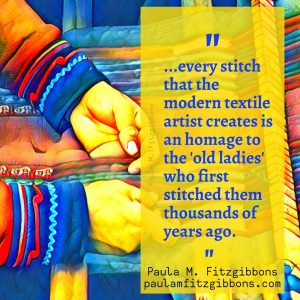
Textile crafts have done perhaps more to further the causes of women than any other economic endeavor. It is an odd reality then that modern artists and crafters often times find ourselves defending our textile of choice. It is even more disturbing that textiles are still frequently belittled as “women’s work” or “old lady activities.” The reality is that every stitch that the modern textile artist creates is an homage to the “old ladies” who first stitched them thousands of years ago. When my ten year old daughter sits beside me weaving the needle through her loom row after row, my son sitting next to his father, both of them knitting, as I myself knit a multitude of colorful stitches into a piece of fabric, the needles of generations of strong, resourceful, creative women stitch along with us.
Indeed, it is “women’s work” that we share, and we are proud to do it.
This post was originally published Mar 22, 2011.


